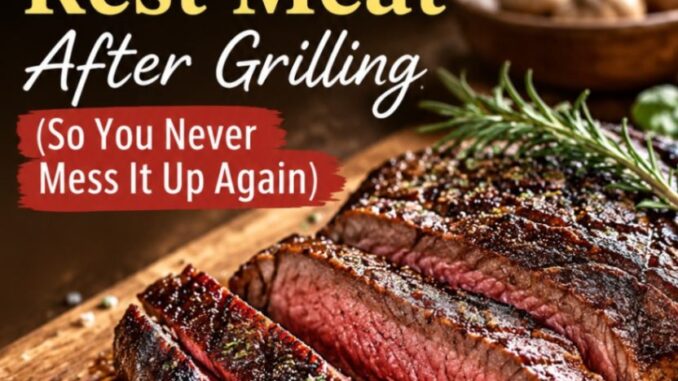
Why You Should Always Rest Meat After Grilling (So You Never Mess It Up Again)
Picture this scenario: You just spent top dollar on a thick, beautiful ribeye steak or a prime rack of pork chops. You fired up the grill, dialed in the heat, tracked the cook time down to the second, and achieved that ideal, smoky, golden-brown crust. It looks incredible. It smells even better. Naturally, your instinct is to slide that hot piece of meat off the grate, set it directly onto a cutting board, and slice right into it.
Then, the tragedy happens.
A red river of savory juices floods across the board, pooling on the counter and running onto the floor. When you take your first bite, the meat feels unexpectedly tough, chewy, and dry. You wonder where you went wrong. Did you overcook it? Was the heat too high? Was it a bad cut of meat?
In nine out of ten cases, the meat itself was perfectly fine, and your grilling technique was completely on point. The mistake happened after you took it off the heat. You skipped the single most critical, non-negotiable step in the entire cooking process: resting your meat.
Resting meat isn’t an optional chef’s trick reserved for high-end steakhouses, nor is it a tedious waste of time standing between you and your dinner. It is simple, foundational food science. If you want consistently tender, insanely juicy, perfectly cooked meat every single time you light the grill, understanding and mastering the rest period is mandatory.
The Science of What Happens Under the Hood
To understand why resting is so important, you have to understand what high heat does to muscle tissue during the grilling process.
Meat is composed primarily of water, muscle fibers (proteins), and fat. Roughly 75% of a raw steak’s weight is water trapped within tiny cellular pockets inside the muscle proteins. When you place a piece of meat over the intense, direct heat of a grill, a few dramatic physical transformations begin immediately:
-
Muscle Fibers Constrict: High temperatures cause the long protein fibers in the meat to tighten and contract, much like wringing out a wet sponge.
-
Moisture Shifts Position: As the outer layers of the meat heat up faster than the center, the contracting muscle fibers squeeze the water away from the hot outer surface toward the cooler center of the cut.
-
Internal Pressure Builds: The water inside the meat turns to hot liquid and steam, creating high internal pressure trapped inside the center of the muscle structure.
If you slice into a piece of meat immediately after pulling it off the grill, while those muscle fibers are still tense and the internal pressure is at its peak, you give all that trapped moisture a path of least resistance. The pressure releases instantly, and the liquid pours out onto your plate. Once that juice leaves the meat, it is gone forever; no amount of butter or sauce can put it back.
When you allow the meat to rest on a warm board or platter away from direct heat, two critical things happen:
-
Muscle Fibers Relax: As the temperature lowers slightly, the constricted protein strands loosen up and open back up.
-
Juices Reabsorb and Viscosity Increases: As the internal temperature cools down from boiling levels, the hot liquid thickens slightly and relaxes back into the open spaces between the muscle fibers.
When you finally slice into a well-rested piece of meat, the juice stays locked inside the cellular structure where it belongs. Every single bite turns out tender and moist instead of dry and rubbery.
The Hidden Power of Carryover Cooking
There is another vital scientific factor at play while your meat sits on the counter: carryover cooking.
When you remove meat from a hot grill, it does not stop cooking instantly. The intense heat built up on the exterior crust continues to travel inward toward the cooler center. This process can cause the internal temperature of your meat to rise anywhere from 5°F to 15°F after it has been removed from the fire.
Ignoring carryover cooking is one of the quickest ways to ruin a meal. If you leave a steak on the grill until a digital thermometer reads your exact desired doneness—say, 135°F for medium-rare—and then pull it off, carryover cooking will push that internal temp up to 140°F or 145°F while it rests. By the time you eat, your medium-rare steak has drifted into medium-well territory.
To hit your target doneness perfectly every single time, you must pull your meat off the grill 5°F to 10°F lower than your final target internal temperature, allowing carryover cooking to finish the job during the rest period.
Guidelines for Resting Every Type of Meat
Not all cuts of meat are created equal, which means resting times are not one-size-fits-all. A thin flank steak requires a completely different approach than a whole grilled turkey or a ten-pound pork shoulder.
Here is your detailed guide on how to handle resting for every major category of grilled protein.
1. Small & Thin Cuts (Flank Steak, Skirt Steak, Pork Chops, Thin Cutlets)
-
Target Rest Time: 3 to 5 minutes
-
Carryover Temp Rise: 2°F to 5°F
Thin cuts cook quickly and lose heat rapidly once removed from the grill. Because they lack massive thermal bulk, carryover cooking is minimal. Rest these cuts uncovered on a warm plate or board just long enough for the surface heat to equalize throughout the piece. Slicing too soon will still drain them, but resting them too long will serve them cold.
2. Standard Thick Cuts (Ribeyes, New York Strips, Filet Mignon, Thick Pork Chops)
-
Target Rest Time: 8 to 10 minutes
-
Carryover Temp Rise: 5°F to 8°F
For standard 1.5-inch to 2-inch thick steaks and chops, the golden rule of thumb is to rest the meat for roughly half the total time it spent on the grill, or about 8 to 10 minutes. This allows plenty of time for the aggressive heat from direct searing to dissipate evenly while keeping the center hot and juicy.
3. Bone-In Poultry (Chicken Breasts, Thighs, Turkey Parts)
-
Target Rest Time: 10 to 12 minutes
-
Carryover Temp Rise: 5°F to 10°F
Poultry needs adequate resting time just as much as beef or pork. Chicken breast is notoriously prone to drying out; resting allows the juices to redistribute so the meat remains tender. Because poultry skin can turn soggy if covered tightly, let grilled chicken rest uncovered in a draft-free spot.
4. Large Roasts & Whole Birds (Whole Chickens, Prime Rib, Pork Loin, Leg of Lamb)
-
Target Rest Time: 15 to 20 minutes
-
Carryover Temp Rise: 8°F to 12°F
Large roasts retain immense amounts of heat. When you pull a prime rib or whole chicken off the grill, the outer layers are burning hot. A 15- to 20-minute rest gives the massive volume of internal muscle fibers time to uncoil and retain their liquid structure.
5. Low & Slow Barbecue (Pork Shoulder, Beef Brisket, Whole Rib Racks)
-
Target Rest Time: 30 minutes to 2 hours
-
Carryover Temp Rise: Minimal during extended rest, but collagen breakdown continues
Tough cuts cooked low and slow at 225°F to 250°F benefit from the longest rest of all. A brisket or pork butt pulled at 203°F needs to sit inside an insulated cooler (wrapped in butcher paper or foil and towels) for at least an hour—and up to three hours. This slow, gradual cooling period allows rendered collagen and gelatin to set into a luscious, succulent glaze that permeates every fiber of the meat.
Golden Rules for Executing the Perfect Rest
To get the best results without serving lukewarm or soggy food, follow these step-by-step rules whenever you wrap up a grilling session.
Rule 1: Use a Wire Rack or Cutting Board, Not a Flat Plate
Placing hot meat directly onto a flat, solid porcelain plate or glass tray traps steam underneath the bottom crust. That trapped moisture ruins your beautiful, crispy sear and turns the underside soggy. Instead, rest your meat on a wooden cutting board (which naturally absorbs excess surface moisture without pulling away heat) or elevated on a wire cooling rack set over a baking sheet. The wire rack allows air to circulate freely beneath the crust.
Rule 2: Foil Wisely (Tenting vs. Wrapping)
A common mistake is wrapping hot meat tightly in aluminum foil while it rests. Tenting is fine, but tight wrapping creates an oven effect that holds in trapped steam, destroying your caramelized crust and overcooking the interior through excessive carryover heat.
-
To Tent Correctly: Shape a piece of aluminum foil into a loose dome or “tent” and drape it loosely over the meat. Leave the sides open so excess steam can escape while radiation heat remains trapped inside.
-
When to Leave Uncovered: If you cooked a high-heat steak or chicken with crispy skin and you want to preserve that maximum crunch, skip the foil tent entirely. Just rest it uncovered in a warm, draft-free room.
Rule 3: Do Not Probe or Pierce During the Rest
Once you pull the meat off the grill, leave it alone. Resisting the urge to poke, prod, or slice into it to check the color is crucial. Every time you pierce the meat with a fork or knife during the rest phase, you create an escape hatch for pressurized juices. Trust your thermometer reading taken right at the end of the cook, set your timer, and step away.
Rule 4: Mind the Ambient Room Temperature
Resting meat on a cold stone countertop in a chilly kitchen during winter will cool your steak down way too quickly, leaving you with cold fat and a lukewarm center. Always set your resting board in a warm area of the kitchen—near the warm stove or inside an oven that is turned off—away from open windows, running fans, or air conditioning vents.
Rule 5: Re-Flash for Hot Crust (Optional Professional Technique)
If you are worried that resting a steak for 10 minutes will leave the exterior crust too cool to your liking, use the restaurant “re-flash” method. Rest the steak fully for 8 minutes. Right before serving, drop it back onto a screaming-hot grill or into a hot skillet with a dab of butter for just 30 to 45 seconds per side. This re-crisps the exterior crust and brings the surface temperature back up to piping hot without cooking the interior or losing any stored juices.
Never Mess It Up Again
Grilling should be a rewarding experience, not a guessing game where you hope for the best every time you slice into a meal.
By treating the rest period as an essential, non-negotiable step in the cooking process—rather than a delay before eating—you take complete control over your food’s texture, moisture, and temperature. Pull your meat off the grates a few degrees early, set it on a board, step away for a few minutes, and let physics do the rest of the work for you.
The reward is unmistakable: ultra-juicy, melt-in-your-mouth perfection on every single plate, every single time.
Leave a Reply