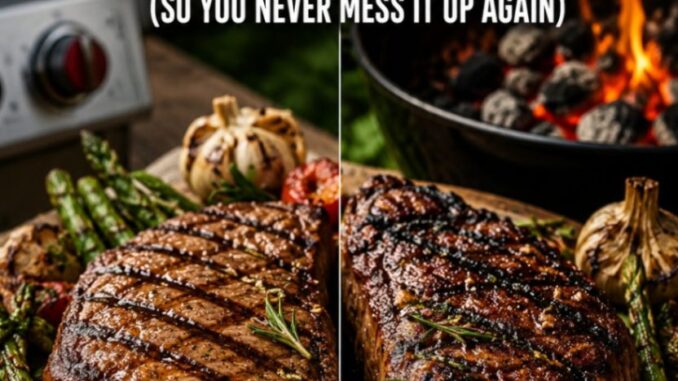
Gas Grill vs. Charcoal Grill: Which Is Better? (So You Never Mess It Up Again)
There is a specific kind of quiet panic that strikes right around 5:30 PM on a Saturday. You’ve got a tray of seasoned ribeyes resting on the counter, a few cold drinks chilling in the cooler, and a yard full of hungry people expecting culinary perfection.
Then you stand in front of the grill, lighter in hand, and realize you’re second-guessing everything.
Should you have gone with the instant gratification of gas? Or are you sacrificing that legendary, wood-fired flavor by not wrestling with a chimney starter and a bag of lump charcoal?
The debate between gas and charcoal grills is as old as suburban backyards, and both sides have fierce loyalists who will defend their preferred fuel source like a family heirloom. But if you’re looking to invest in a new setup—or simply want to stop ruining expensive cuts of meat—you don’t need dogmatic opinions. You need a practical, no-nonsense breakdown of how these two heavyweights actually perform in the real world.
Let’s settle the score once and for all so you can buy with confidence and never mess up cookout night again.
The Core Difference: How They Heat Your Food
Before diving into flavor profiles and maintenance routines, it helps to understand the fundamental physics at play. Heat isn’t just heat; the way thermal energy is delivered to your food radically changes the final result.
Gas Grills: The Precision Instrument
Gas grills run on either liquid propane (from a portable tank) or natural gas (plumbed directly from your home line). When you turn the knob and press the igniter, gas flows through burner tubes and ignites, creating open flames beneath metal heat diffusers—often called flame tamers, flavorizer bars, or heat tents.
These bars radiate heat upward toward the grates and vaporize any drippings that fall, creating a light mist of steam and flavor.
-
Primary Heat Type: Mainly convection (hot air circulating around the food) combined with conduction (direct contact with hot metal grates).
-
Control Level: Extremely high. You have literal control knobs to dial in temperatures down to the degree.
Charcoal Grills: The Radiator of Raw Power
Charcoal grills are beautifully simple vessels designed to hold burning carbonized wood (briquettes or lump charcoal). There are no mechanical valves, gas lines, or electrical igniters. Temperature control is managed entirely by controlling airflow via intake and exhaust dampers.
-
Primary Heat Type: High-intensity radiant heat (infrared light emitted directly from glowing embers) alongside convection and conduction.
-
Control Level: Manual and organic. Adjusting heat requires moving coals around or tweaking airflow vents, demanding a bit of patience and practice.
Round 1: Flavor Profile
Let’s address the elephant in the yard first: Does charcoal actually taste better?
The short answer? Yes, but with an important caveat.
The Charcoal Advantage
Charcoal produces a distinct, authentic flavor that gas simply cannot replicate on its own. When you burn hardwood lump charcoal, you are burning real organic wood matter. As it combusts, it releases complex chemical compounds—like lignin—which produce wood smoke rich in aromatic substances.
Furthermore, charcoal gets hotter than standard gas burners. When fat drippings hit red-hot coals, they don’t just vaporize; they incinerate instantly, producing a rich, smoky vapor filled with fatty acids that coats the food as it rises. That signature “backyard BBQ” aroma? That’s pure charcoal at work.
The Gas Reality
Gas itself (propane or methane) is clean-burning. It produces water vapor and carbon dioxide as byproducts, leaving zero natural smoky flavor behind. Any flavor you get on a gas grill comes entirely from two sources:
-
The Maillard reaction (the browning of amino acids and sugars on the surface of the meat from direct contact with heat).
-
Drippings hitting those metal flavorizer bars and smoking back up.
While a gas grill will still give you a delicious, beautifully seared steak or burger, it won’t have that deep, wood-fired pitmaster essence.
Winner: Charcoal. If pure, rich, smoky flavor is your top priority, nothing beats real wood coals.
Round 2: Speed, Convenience, and Usability
Flavor is king, but convenience is the absolute dictator of everyday cooking habits.
Ask yourself this question: How often do you want to grill on a random Tuesday night after a long day at work?
The Gas Advantage: Fire at the Push of a Button
Gas grills are the ultimate convenience machines.
-
Startup Time: 60 seconds. Turn the gas valve, click the igniter, set your knobs, and walk away.
-
Preheat Time: 10 to 15 minutes to reach 500 degrees celcius
-
Shutdown: Turn the knobs off, brush the grates, close the lid. Done.
Because the temperature is regulated by valves, you can easily set up multi-zone cooking—keeping one burner on high for searing and another on low for gently warming delicate items like fish or vegetables.
The Charcoal Struggle: The Craft Takes Time
Charcoal requires pre-planning and physical effort.
-
Startup Time: 15 to 25 minutes just to get coals properly lit using a chimney starter (please, for the love of good food, ditch the lighter fluid—it makes your meat taste like kerosene).
-
Preheat Time: Another 10 to 15 minutes once the coals are dumped into the basin and the grates warm up.
-
Shutdown: You can’t just “turn off” coals. You have to close all vents to starve the fire of oxygen and wait hours for the grill to cool completely before cleaning up ash.
Winner: Gas. For busy parents, weekday meal-preppers, or anyone who values quick setup and effortless control, gas wins by a mile.
Round 3: Temperature Range and Cooking Versatility
Different foods require wildly different thermal environments. A thick pork shoulder needs low, gentle heat 225 degrees celcius for hours. A thin skirt steak needs face-melting heat (700 degrees celcius ) for three minutes.
| Feature | Gas Grill | Charcoal Grill |
| Max Temperature | $500^\circ\text{F} – 600^\circ\text{F}$ (Standard) | $700^\circ\text{F} – 1000^\circ\text{F}+$ |
| Low-and-Slow Capabilities | Moderate (Requires precise burner tweaking) | Excellent (Easy indirect setup) |
| Heat Distribution | Even across zones, prone to wind drafts | Concentrated, highly customizable zones |
| Smoking Capability | Requires smoker box/wood chip foil pouches | Native wood chunk combustion |
Searing Power
Charcoal reigns supreme here. A fresh bed of glowing lump coals can easily top 800degrees celcius to 1000degrees celcius . This raw radiant energy creates an incredible, edge-to-edge crust on steaks while keeping the center rare and juicy. Standard gas grills usually top out around 550 degrees celcius to 600 degrees celcius unless you buy a high-end model equipped with a dedicated infrared sear burner.
Low-and-Slow Smoking
Want to smoke a rack of ribs or a brisket?
-
On a charcoal grill (especially kettle-style or ceramic kamado models), you can arrange your coals in a “snake method” or bank them to one side, add chunks of hickory or applewood, and maintain a steady 225 degrees celcius for 8+ hours.
-
On a gas grill, keeping temperatures that low can be tricky. Open flames tend to hover around 270 degrees celcius even on the lowest burner setting, and introducing smoke requires accessory wood-chip boxes that need constant refilling.
Winner: Charcoal. It offers a much wider usable temperature envelope, from gentle smoking to steakhouse-level high-heat searing.
Round 4: Cleaning and Maintenance
Nobody likes cleaning up after a feast, but grill maintenance directly impacts the lifespan of your machine and the taste of your food.
Cleaning a Gas Grill
Gas grills have more moving parts, which means more surfaces for grease to hide.
-
Routine Clean: Brush the grates while hot before or after every cook. Empty the grease tray beneath the belly every few cooks.
-
Deep Clean (Twice a Year): Scrape down the flavorizer bars, clean out burner tube ports to ensure even gas flow, and vacuum out accumulated debris in the cookbox.
Cleaning a Charcoal Grill
Charcoal grills have very few moving parts, but they generate ash—lots of it.
-
Routine Clean: After every cook, you must sweep out the cooled wood ash. Leaving ash in the grill is dangerous because ash absorbs moisture from the air, creating a corrosive paste that eats through steel and iron cookboxes.
-
Deep Clean: Scrape the inside of the bowl periodically to remove flakes of carbonized grease smoke (often mistaken for peeling paint).
Winner: Tie. Gas requires managing grease traps and burner parts; charcoal requires constant ash disposal. Pick your poison.
Round 5: Long-Term Cost and Value
When looking at price, you have to factor in both the upfront purchase cost and the ongoing fuel expenses.
Purchase Price
-
Charcoal Grills: Unbeatable entry cost. You can pick up a classic, high-quality $22$-inch Weber Kettle grill that will last a decade for around $120 to $200. High-end ceramic Kamado grills will run $800 to $1,500+, but basic kettle models are accessible to almost any budget.
-
Gas Grills: Higher entry point. A reliable entry-level gas grill with quality burners and a sturdy cart starts around $350 to $500. Premium gas units easily stretch into the thousands.
Fuel Costs
-
Propane: A $20$-lb tank refill costs around $20 to $25 and provides roughly 18 to 20 hours of cooking time on a standard three-burner grill. That breaks down to about $1.00 – $1.25 per cook.
-
Charcoal: A good $15$-lb bag of quality lump charcoal or briquettes costs around $15 to $20. A single solid grilling session uses a chimney’s worth (about 3–5 lbs), costing roughly $3.00 – $5.00 per cook.
While charcoal grills are significantly cheaper to buy upfront, gas is actually cheaper per cook in the long run.
Winner: Charcoal for budget buyers; Gas for frequent, high-volume cooks looking for lower fuel costs over time.
How to Never Mess It Up Again: Quick Rules of Thumb
Regardless of which fuel source you choose, most ruined backyard meals come down to a few preventable mistakes. Here is your cheat sheet to absolute mastery.
The 3 Golden Rules of Gas Grilling
-
Always Preheat with the Lid Closed: Don’t just light it and drop food on cold grates. Give it 15 minutes to let the metal grates store thermal energy so your food doesn’t stick.
-
Master Two-Zone Cooking: Never burn all burners at the same height. Keep one side on High/Medium for searing, and one side on Low or turned Off completely. If fat flares up, move the food to the cool zone immediately rather than burning it.
-
Keep the Lid Down: Gas grills heat primarily through convection. Every time you open the lid, you dump all your heat into the air, causing dramatic temperature drops.
The 3 Golden Rules of Charcoal Grilling
-
Ditch the Lighter Fluid: Petroleum-based fluids leave bad odors and foul flavors on your grates. Spend $20 on a metal chimney starter and use rolled-up newspaper or paraffin wax cubes to light your coals cleanly.
-
Wait for the Ash-Over: Never put food over black, freshly lit coals. Wait until the coals are covered in a fine layer of gray ash and glowing red underneath (usually 15–20 minutes after lighting).
-
Use the Vents, Not the Lid: Temperature control is air control. Opening the bottom vent lets more oxygen in, making the fire hotter. Closing the vents starves the fire, cooling it down.
The Verdict: Which One Should You Buy?
At the end of the day, the best grill is the one you will actually use.
Choose a Gas Grill if:
-
You prioritize speed, convenience, and low-friction weekday cooking.
-
You cook delicate foods often (fish, veggies, fruit) where heavy wood smoke might overpower the dish.
-
You hate dealing with messy ash disposal.
-
You cook for large groups frequently and need precise temperature management across big surfaces.
Choose a Charcoal Grill if:
-
You consider outdoor cooking a weekend ritual, hobby, or craft—not just a chore.
-
You crave deep, authentic wood-smoke flavor and steakhouse-quality high-heat searing.
-
You want a multi-use rig that can handle both quick burgers and low-and-slow smoking.
-
You want maximum performance while keeping your upfront equipment investment low.
The Ultimate Secret?
If you have the space and budget, many experienced pitmasters own both. Use the gas grill for quick Tuesday night chicken breasts, and fire up the charcoal kettle when you have the time to sit back, sip a drink, and enjoy the process.
Pick the tool that fits your lifestyle, follow the heating fundamentals, and you’ll never serve a burnt or dried-out meal again.
Leave a Reply